This post is a follow-up to my post, THE KEY(WORDS) TO ADVERTISING. Will 2004 be the year for an advertisement boom on weblogs?
Martin Nisenholtz of New York Times Digital is interviewed (Putting blogs in their place) in Wired Magazine. He gives the reporter mixed signals, don't you think?
Is Google's AdSense program the winning horse, or will Henry Copeland's Blogads be the dark horse? Mr. Copeland said in David Ranii's article, Blog plugs appeal to niche audiences, that "Blogads had a slow start, but business has surged this year." Could Glenn Reynold's decision to place Blogads be a significant reason for the explosion of ads on weblogs?
The commercialism of the blogosphere has recently become a hot topic. Adam Herman of MediaPost.com, wrote an article with the title, New Ad Models Take Flight, and Kate Kaye had a segment titled, Blogs Make a Ripple in Media Pool. Here is an excerpt:
"Although Blogads appears to be the only blog-exclusive advertising network around, it's not the only means of attracting the opinionated and influential people reading blogs. Advertisers can run text ads on the Textads Dot Biz network, which features about 100 blog sites. Viral marketers can use Blogstakes, a sweepstakes service that gives prizes like books from humor publisher The Onion to bloggers who link to and refer winners to an advertiser's contest. And Richards Interactive, an agency that has developed blog marketing strategies for Home Depot and Dr Pepper's Raging Cow, employs a network of influential bloggers to spur word-of-Net on their blogs for advertiser clients." (MediaPost Communications, April 2004 Issue.)
Jeff Jarvis was moderator of a IRC session ("Blogging as a Business") at BloggerCon on April 8. I think that the following statement from Jeff's post, BloggerCon wiki open for business: Making blogs make money, is very crucial for the future success of advertising on weblogs:
"$ We can target advertising on relationships [Editor's note: Emphasis added.], not just on adjacency (print) or gross audience size (broadcast) or word coincidences (Google)."
I am happy with the continuously steady stream of clicks thru Google's AdSense program, and it is interesting to watch how the search engine robot is coming up with matching ads for my blog. For some interesting examples on how you could make money on advertising, read the articles, The Hundred Dollar Click by Jay Currie, and Hands Off My Google by Rick Aristotle Munarriz [Editor's note: Great middle name, b.t.w.]. Dean Esmay points out some hilarious examples of ads generated on his blog, in his post, Google Ad Quirk.
I think that the Blogads idea will catch on in the future and create a paradigm shift of the advertising business. A new dimension of social networking will emerge and give room for the exchange of ideas, services and products. Click here for an example on how I got in touch with a supporter and advertiser.
Is an advertisement on your blog a proof that you have "sold out," paraphrasing Tim Blair in his post, Open For Business? ;) I don't think so. On the contrary, I think it is an opportunity to add value to your blog and introduce new sources of interesting stuff to your readers. You could also use blogads in order to promote non-for-profit things. Here is an excerpt from Daniel Henninger's article, Spirit of America:
"The First Marine Expeditionary Force and U.S. Army in Iraq want to equip and upgrade seven defunct Iraqi-owned TV stations in Al Anbar province--west of Baghdad--so that average Iraqis have better televised information than the propaganda they get from the notorious Al-Jazeera. If Jim Hake can raise $100,000, his Spirit of America will buy the equipment in the U.S., ship it to the Marines in Iraq and get Iraqi-run TV on the air before the June 30 handover."
A Small Victory and Dean's World have together started a "campaign to raise funds for U.S. Marines to equip TV stations in Iraq." I think it is a good cause to take up the fight against the propaganda spread by "Jihad TV"... Maybe this is the start of a "Radio Free Middle East"?
I want to end this post by informing my readers that you could find my blog in a new directory compiled by Commissar of The Politburo Diktat. My blog is listed in the "War Bloggers Yellow Pages."
UPDATE 04/19/04: Wow! That was a quick "response" from the traditional media! Is the media attention a sign that blog advertising is catching on? Maybe the journalists at NYT and WP are reading my blog?! ;) [Editor: Note to self: Check Site Meter's referral report for "NYT" and "WP" URLs... *grin* ;)]
Read the following articles [found via Henry Copeland]:
Many Started Web Logs for Fun, but Bloggers Need Money, Too by Julie Flaherty (NYT Technology).
Some Candidates Turn To Blogs to Place Ads: Sites are Low-Cost, Reach Thousands by Brian Faler (WP 2004 Election).

Sunday, April 18, 2004

Friday, April 16, 2004
THE WAR IS COMING CLOSER TO HOME...
It is terrible to hear that an American soldier (Keith Matthew Maupin) has been taken hostage in Iraq. The war is coming closer to my former home town, southwest of Ohio. Batavia is about 85 miles south of Troy.
Related: My post, THE WAR IS COMING CLOSER... ON A PERSONAL LEVEL.
Related: My post, THE WAR IS COMING CLOSER... ON A PERSONAL LEVEL.
Thursday, April 15, 2004
80% OF THE POLITICIANS ARE VOTING FOR KERRY...
A Swedish newspaper ("The Swedish Daily," a paper with a conservative / moderate "republican" point of view) has conducted a survey and got the result that 80% of the members of the Swedish Parliament are favoring Kerry over Bush as the next President of the United States.
OSAMA BIN LADEN'S MIXED TAPES...
Osama bin Laden latest tape is a signal that he wants to get involved in politics by blackmail and giving an offer of a truce to the European leaders. The Sun says "Peace off Bin Laden" and sends a tape to bin Laden via "Al Arabiya, Al Jazeera, and the Al Hayat Arabic newspaper — as well as broadcasting it online around the world." (The Sun.)
UPDATE 04/16/04: For more on the tape, including a full transcript, go to Right Voices and read Reilly's post, bin Laden Offers Truce.
UPDATE 04/16/04: For more on the tape, including a full transcript, go to Right Voices and read Reilly's post, bin Laden Offers Truce.
Wednesday, April 14, 2004
DEPRESSING NEWS COVERAGE
Glenn Reynolds' post on the relation between following the news and depression got me thinking about my own blogging and how writing posts and comment on daily news could get you in a bad mood. Here is a quote from Glenn's post: "I said over a year ago that if I ever quit blogging it would be because I got tired of that."
I still enjoy blogging and I will continue to blog as long as I think it is fun and I get something out of it. I will soon have my second blogiversary. I have enjoyed the comments and feedback I get from my posts, and I have met several individuals online who I share the same core-values with. I look forward to meet some of them on my future trip to the Land of Opportunity - America. I am in one way, "journalistic" speaking, pessimistic about the future of the world, but philosophically, I am more positive about the future to come. That's why I will continue to be an "armchair general" and fight the battle of ideas. On a personal note, my life is guided by an integrated system of ideas, and I am seeking the pursuit of happiness by achieving my values.
The good thing with the net and especially the blogosphere, is that you could find positive and upbeat news, different views than traditional media, and people who are fact-checking newspapers and TV-programs. But I must admit that I almost have stopped to follow the Swedish media due to the fact it is so left-leaning and biased against America. I miss my daily dose of Fox News! I am really starting to feel isolated here. My blog project Lukeion has therefore not been so active as planned, but I will still continue to post updates now and then. My goal was to enroll several Swedes and create a group blog of some sort, but as it is now I will continue do the posting with additional op-eds from friends who I know.
In order to stay sane and don't get too angry and depressed about the anti-American attitude in the Swedish media, I will take a pro-active position and get involved in a new association called the Swedish-American Association. With all my criticism of the biased media coverage in Sweden, I want to take a moment and point you to a great exception from situation, and that's Watch by Mårten Barck (freelance journalist, living in Stockholm, Sweden).
You are more than welcome to give me tips and suggestion on good news sources, and how you cope with following the daily news. Please send me an email message or comment on this post.
UPDATE 04/15/04: I'm sad to hear that Michele Catalano (A Small Victory) is taking a break, but I hope she will be back in the near future. Michele Catalano & Alan Nelson's Command Post is mentioned in the article, A boom time for blogs and bloggers. I will miss A Small Victory and Rachel Lucas for being good company and virtual "neighbors" @ Cox & Forkum's blogroll...
I was contemplating awhile ago on taking a break from blogging after I had read some nasty comments in cyberspace about my blog and my values, but then I changed my mind. So, here I am, fit for fight! Bring 'em on!
I still enjoy blogging and I will continue to blog as long as I think it is fun and I get something out of it. I will soon have my second blogiversary. I have enjoyed the comments and feedback I get from my posts, and I have met several individuals online who I share the same core-values with. I look forward to meet some of them on my future trip to the Land of Opportunity - America. I am in one way, "journalistic" speaking, pessimistic about the future of the world, but philosophically, I am more positive about the future to come. That's why I will continue to be an "armchair general" and fight the battle of ideas. On a personal note, my life is guided by an integrated system of ideas, and I am seeking the pursuit of happiness by achieving my values.
The good thing with the net and especially the blogosphere, is that you could find positive and upbeat news, different views than traditional media, and people who are fact-checking newspapers and TV-programs. But I must admit that I almost have stopped to follow the Swedish media due to the fact it is so left-leaning and biased against America. I miss my daily dose of Fox News! I am really starting to feel isolated here. My blog project Lukeion has therefore not been so active as planned, but I will still continue to post updates now and then. My goal was to enroll several Swedes and create a group blog of some sort, but as it is now I will continue do the posting with additional op-eds from friends who I know.
In order to stay sane and don't get too angry and depressed about the anti-American attitude in the Swedish media, I will take a pro-active position and get involved in a new association called the Swedish-American Association. With all my criticism of the biased media coverage in Sweden, I want to take a moment and point you to a great exception from situation, and that's Watch by Mårten Barck (freelance journalist, living in Stockholm, Sweden).
You are more than welcome to give me tips and suggestion on good news sources, and how you cope with following the daily news. Please send me an email message or comment on this post.
UPDATE 04/15/04: I'm sad to hear that Michele Catalano (A Small Victory) is taking a break, but I hope she will be back in the near future. Michele Catalano & Alan Nelson's Command Post is mentioned in the article, A boom time for blogs and bloggers. I will miss A Small Victory and Rachel Lucas for being good company and virtual "neighbors" @ Cox & Forkum's blogroll...
I was contemplating awhile ago on taking a break from blogging after I had read some nasty comments in cyberspace about my blog and my values, but then I changed my mind. So, here I am, fit for fight! Bring 'em on!
Tuesday, April 13, 2004
APPEASEMENT
Take some time and read Victor Davis Hanson's article, The Fruits of Appeasement. I found this article via Right Voices. Reilly has titled the post, Can One Man Make A Difference? I think so. The real question is if George W. Bush has the guts to continue with his "cowboy style" and go after the next member of the Axis of Evil. The subtitle of Mr. Hanson's article is Sooner or later, we had to face down Islamic terror. What took us so long? Will Bush Jr. go after the Mullahs in Iran, or not?
Here is an excerpt from Hanson's article:
"But if we know how we failed to respond in the last three decades, do we yet grasp why we were so afraid to act decisively at these earlier junctures, which might have stopped the chain of events that would lead to the al-Qaida terrorist acts of September 11? Our failure was never due to a lack of the necessary wealth or military resources, but rather to a deeply ingrained assumption that we should not retaliate—a hesitancy al-Qaida perceives and plays upon." (City Journal, Spring 2004.)
Read Peter Schwartz' hard-hitting article, American appeasement in Iraq. Here is an excerpt from the article:
"In logic and in justice, there is only one means of "winning public support," in Afghanistan or Iraq: eradicating every trace of the former enslavers. If that is not sufficient, then the support is not worth gaining. Our only concern should be toward those who value freedom enough to recognize the inestimable benefit our troops have given them. As to all the others -- they need not like us, only fear us." (Peter Schwartz, 04/12/04.)
Related: My post, THE BATTLE OF IDEAS: CHICKENHAWKS VERSUS PACIFICISTS.
UPDATE 04/14/04: Read Allen Forkum's analysis in the post, Give War A Chance.
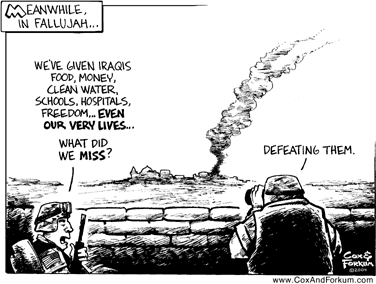
For more cartoons like this, check out John Cox & Allen Forkum's book, Black & White World.
Here is an excerpt from Hanson's article:
"But if we know how we failed to respond in the last three decades, do we yet grasp why we were so afraid to act decisively at these earlier junctures, which might have stopped the chain of events that would lead to the al-Qaida terrorist acts of September 11? Our failure was never due to a lack of the necessary wealth or military resources, but rather to a deeply ingrained assumption that we should not retaliate—a hesitancy al-Qaida perceives and plays upon." (City Journal, Spring 2004.)
Read Peter Schwartz' hard-hitting article, American appeasement in Iraq. Here is an excerpt from the article:
"In logic and in justice, there is only one means of "winning public support," in Afghanistan or Iraq: eradicating every trace of the former enslavers. If that is not sufficient, then the support is not worth gaining. Our only concern should be toward those who value freedom enough to recognize the inestimable benefit our troops have given them. As to all the others -- they need not like us, only fear us." (Peter Schwartz, 04/12/04.)
Related: My post, THE BATTLE OF IDEAS: CHICKENHAWKS VERSUS PACIFICISTS.
UPDATE 04/14/04: Read Allen Forkum's analysis in the post, Give War A Chance.
For more cartoons like this, check out John Cox & Allen Forkum's book, Black & White World.
Monday, April 12, 2004
THE CHICAGO REPORT AND CARNIVAL OF THE CAPITALISTS
This week's edition of Carnival of the Capitalists is hosted by The Chicago Report. I totally agree with Jay Solo in his comment on the animated title. Very nifty and cool, although I don't have the stomach to ride roller-coasters! ;)
Please note that EGO will host the carnival on June 28. Go to Jay Solo's CotC info page for more information.
Please note that EGO will host the carnival on June 28. Go to Jay Solo's CotC info page for more information.
Sunday, April 11, 2004
THE MULLAHS ARE PULLING THE STRINGS IN IRAQ
How much are the Mullahs involved in the chaotic situation in regions controlled by the Shiites? New York Post [via ActivistChat.com] reports:
"U.S. and Israeli intelligence officials said last night there is evidence that Iran's Revolutionary Guards, the security services loyal to Iran's hard-line religious leader Ayatollah al Khameini, have funneled as much as $80 million into Shiite charities established by al-Sadr's influential family that have been diverted to fund his fanatic al-Mahdi militia." (Niles Lathem and Uri Dan, 04/11/04.)
The World Net Daily has more to the story:
"An Iranian defector claims Iran spends $70 million a month on activity in Iraq, according to the London Arabic-Language Daily Al-Sharq Al-Awsat." (WorldNetDaily, 04/10/04.)
Check out Cox & Forkum's post, Iran's Proxy War, for more on the chain of puppets: Iranian Mullahs --> Hezbollah --> al-Sadr --> Shiite militia...
Guess who thinks this story is a conspiracy plot made up by the neo-cons in Washington? Do a search on the above mentioned keywords and you will find that the "peace activists" at "Anti-WarDOTcom" are not happy campers...
UPDATE O4/12/04:
Read Roger L. Simon's post, It's Iran, Stupid! - A Message to the Blogosphere. [Via InstaPundit.]
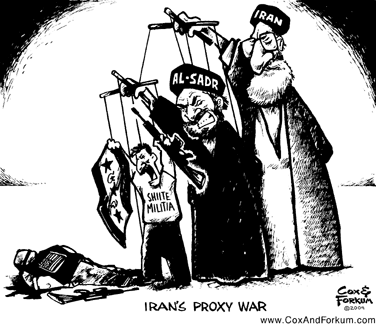
For more cartoons like this, check out John Cox & Allen Forkum's book, Black & White World.
UPDATE 04/15/04: Read The Puppetmasters by Michael Rubin. Here is an excerpt from the article:
"Much of Mr. al-Sadr's financial support is channeled through Ayatollah Kazem al-Haeri, a resident of the Iranian holy city of Qom. Mr. al-Haeri enjoys the close confidence of Ayatollah Ali Khamene'i, Iran's supreme leader, who maintains slush funds for which he is accountable to neither parliament nor president.
According to an April 8, 2004, report in the Italian daily La Stampa, the Italian military intelligence agency Servizio per le Informazioni e la Sicurezza Militare has concluded that Iran's supreme leader sent Muhammad Husayn al-Haeri to Iraq to coordinate efforts to force a coalition withdrawal."
"U.S. and Israeli intelligence officials said last night there is evidence that Iran's Revolutionary Guards, the security services loyal to Iran's hard-line religious leader Ayatollah al Khameini, have funneled as much as $80 million into Shiite charities established by al-Sadr's influential family that have been diverted to fund his fanatic al-Mahdi militia." (Niles Lathem and Uri Dan, 04/11/04.)
The World Net Daily has more to the story:
"An Iranian defector claims Iran spends $70 million a month on activity in Iraq, according to the London Arabic-Language Daily Al-Sharq Al-Awsat." (WorldNetDaily, 04/10/04.)
Check out Cox & Forkum's post, Iran's Proxy War, for more on the chain of puppets: Iranian Mullahs --> Hezbollah --> al-Sadr --> Shiite militia...
Guess who thinks this story is a conspiracy plot made up by the neo-cons in Washington? Do a search on the above mentioned keywords and you will find that the "peace activists" at "Anti-WarDOTcom" are not happy campers...
UPDATE O4/12/04:
Read Roger L. Simon's post, It's Iran, Stupid! - A Message to the Blogosphere. [Via InstaPundit.]
For more cartoons like this, check out John Cox & Allen Forkum's book, Black & White World.
UPDATE 04/15/04: Read The Puppetmasters by Michael Rubin. Here is an excerpt from the article:
"Much of Mr. al-Sadr's financial support is channeled through Ayatollah Kazem al-Haeri, a resident of the Iranian holy city of Qom. Mr. al-Haeri enjoys the close confidence of Ayatollah Ali Khamene'i, Iran's supreme leader, who maintains slush funds for which he is accountable to neither parliament nor president.
According to an April 8, 2004, report in the Italian daily La Stampa, the Italian military intelligence agency Servizio per le Informazioni e la Sicurezza Militare has concluded that Iran's supreme leader sent Muhammad Husayn al-Haeri to Iraq to coordinate efforts to force a coalition withdrawal."
TAX FREE DAY AND GOLD STANDARD
Don't you think it is a good idea to have a post on taxes and money as a commodity, on the Tax Freedom Day? It is a positive sign that this day has come earlier this year than last year, in fact it is hasn't been as early as this date since 1967. George W. Bush should get credit for this. It's time for him to pay some attention to the monetary policy.
A person with the username "Joe Enterprise" has written an entry on EGO forum about today's economical situation and the power of the Federal Reserve, and his solution to the problem is something called "American Liberty Dollars." I don't know anything about this specific medium of exchange, but maybe my post could spark a discussion on why the system with fiat money has been generally accepted around the world, and suggestions on how we could return to an objective way of exchange, such as the gold standard.
Here is a clear statement from the Warsaw Business Journal:
"Since the Eighth Century in China, hundreds of fiat-money monetary systems have been attempted and have failed 100 percent of the time. The main reason they fail is because whenever bankers and/or politicians are left in charge of the integrity of fiat money, the temptation to manipulate that money has been so overwhelming that none of them has been able to resist it. In every case, they have driven the purchasing power of the fiat money down to its cost of production, which is nearly zero.
Until 1971 there was some protection as the U.S. dollar was pegged to the price of gold and all other currencies derived their value from it. Once this was abandoned under Nixon, the Fed became the lender of last resort and began to control the world economy by the extension of credit." (Zbigniew Piekarski, 03/15/04.)
I wonder if Alan Greenspan has totally blanked-out what he wrote in 1966... Here is an excerpt from his essay, Gold And Economic Freedom, published in Ayn Rand's book, Capitalism: The Unknown Ideal:
"The abandonment of the gold standard made it possible for the welfare statists to use the banking system as a means to an unlimited expansion of credit. They have created paper reserves in the form of government bonds which - through a complex series of steps - the banks accept in place of tangible assets and treat as if they were an actual deposit, i.e., as the equivalent of what was formerly a deposit of gold." [Paperback edition, page 101.]
Don Luskin is getting some facts straighten out about the role of the Federal Reserve and the chairman and his thoughts, in his article, The FED, Alan Greenspan, and Ayn Rand. If you want to get some nuggets of valuable information on the so-called "gold bugs", read Mark Da Cunha's interview with Richard Salsman. For some additional comments by Mr. Salsman, read Robert W. Tracinski's article, The economics of war.
If you are interested in learning more about the banking system and economics, I recommend you to read the following books:
Breaking The Banks: Central Banking Problems And Free Banking Solutions and Gold And Liberty by Richard Salsman. You could purchase the books from the American Institute for Economic Research.
CRA$HMAKER - A Federal Affaire by Victor Sperandeo. I met "trader Vic" on my first visit to America in 1996. You could read an review of the book in Freemarket Gold & Money Report.
Principles of Economics by Carl Menger.
I will end this post with an excerpt from Carl Menger's On the Origins of Money:
"Finally the precious metals, in consequence of the peculiarity of their colour, their ring, and partly also their specific gravity, are with some practice not difficult to recognise, and through their taking a durable stamp can be easily controlled as to quality and weight; this too has materially contributed to raise their saleableness and to forward the adoption and diffusion of them as money." (Economic Journal, volume 2, (1892) p. 239-55. Translated by C.A. Foley.)
I wonder if Harvey Olson of "Bad Money" has a "greenback" with the words "in goLd we trust" in his "Graffiti Currency" collection...
A person with the username "Joe Enterprise" has written an entry on EGO forum about today's economical situation and the power of the Federal Reserve, and his solution to the problem is something called "American Liberty Dollars." I don't know anything about this specific medium of exchange, but maybe my post could spark a discussion on why the system with fiat money has been generally accepted around the world, and suggestions on how we could return to an objective way of exchange, such as the gold standard.
Here is a clear statement from the Warsaw Business Journal:
"Since the Eighth Century in China, hundreds of fiat-money monetary systems have been attempted and have failed 100 percent of the time. The main reason they fail is because whenever bankers and/or politicians are left in charge of the integrity of fiat money, the temptation to manipulate that money has been so overwhelming that none of them has been able to resist it. In every case, they have driven the purchasing power of the fiat money down to its cost of production, which is nearly zero.
Until 1971 there was some protection as the U.S. dollar was pegged to the price of gold and all other currencies derived their value from it. Once this was abandoned under Nixon, the Fed became the lender of last resort and began to control the world economy by the extension of credit." (Zbigniew Piekarski, 03/15/04.)
I wonder if Alan Greenspan has totally blanked-out what he wrote in 1966... Here is an excerpt from his essay, Gold And Economic Freedom, published in Ayn Rand's book, Capitalism: The Unknown Ideal:
"The abandonment of the gold standard made it possible for the welfare statists to use the banking system as a means to an unlimited expansion of credit. They have created paper reserves in the form of government bonds which - through a complex series of steps - the banks accept in place of tangible assets and treat as if they were an actual deposit, i.e., as the equivalent of what was formerly a deposit of gold." [Paperback edition, page 101.]
Don Luskin is getting some facts straighten out about the role of the Federal Reserve and the chairman and his thoughts, in his article, The FED, Alan Greenspan, and Ayn Rand. If you want to get some nuggets of valuable information on the so-called "gold bugs", read Mark Da Cunha's interview with Richard Salsman. For some additional comments by Mr. Salsman, read Robert W. Tracinski's article, The economics of war.
If you are interested in learning more about the banking system and economics, I recommend you to read the following books:
Breaking The Banks: Central Banking Problems And Free Banking Solutions and Gold And Liberty by Richard Salsman. You could purchase the books from the American Institute for Economic Research.
CRA$HMAKER - A Federal Affaire by Victor Sperandeo. I met "trader Vic" on my first visit to America in 1996. You could read an review of the book in Freemarket Gold & Money Report.
Principles of Economics by Carl Menger.
I will end this post with an excerpt from Carl Menger's On the Origins of Money:
"Finally the precious metals, in consequence of the peculiarity of their colour, their ring, and partly also their specific gravity, are with some practice not difficult to recognise, and through their taking a durable stamp can be easily controlled as to quality and weight; this too has materially contributed to raise their saleableness and to forward the adoption and diffusion of them as money." (Economic Journal, volume 2, (1892) p. 239-55. Translated by C.A. Foley.)
I wonder if Harvey Olson of "Bad Money" has a "greenback" with the words "in goLd we trust" in his "Graffiti Currency" collection...
Saturday, April 10, 2004
VOTER'S DILEMMA?
Here is a new column by Burgess Laughlin:
Voter's dilemma?
Michael Hurd has written a very brief, but thought-provoking article, Meaningful Blows From the 9/11 Commission, on the site for Capitalism Magazine.
The title of the article does not accurately name the theme. The following paragraph [Editor's note: I excerpted the whole paragraph according to Capitalism Magazine's policy of maximum 250 words.] of the article summarizes his main point:
"George W. Bush is a seriously flawed President, so flawed that I am seriously considering abstaining from voting in November. However, his willingness to use force against our obvious and known enemies is one of the few reasons for praising him, not criticizing him. If I do end up voting for him, this will be the sole reason why." (Capitalism Magazine, 04/09/04.)
Hurd's possible decision to not vote (at least not for president) raises a question that applies to everyone living in a free or even merely semi-free republic: Why vote at all?
The only justification that I can see is the belief that voting (and the advocacy that goes with it) might improve political conditions for me and for all peaceful and honest individuals with whom I trade.
In the U. S., the justification for voting is easier to see on local ballot measures -- e.g., whether a local government should raise a certain tax. Sometimes, out of thousands of votes cast, a few votes may decide the fate of an electoral issue. My vote might help reject a tax increase. (Of course, in a wholly free republic, such issues would never appear on a ballot.)
Voting for particular politicians is harder to justify. The main reason is that the institutionalized nominating process almost always proposes compromisers who stand halfway between the competing statist factions. The left-wing statists offer us such programs as freedom to choose an abortion (a great benefit to some rational individuals); and the right-wing statists offer us a cut in the capital-gains tax (a great benefit to some rational individuals). On the other hand, leftists favor more restrictions on earning wealth, while rightists support limiting our spending to religiously correct items.
Amidst this dilemma, rational voters must try to pick the least destructive candidates for the long-term. In that case, what criterion or criteria should the rational voter use to select one candidate over another?
I can suggest one approach. It is standard objective procedure: essentialize. The rational voter must identify which political issues are more fundamental (causing more effects) than the others. For example, defense of the republic -- from terrorists, invaders, seditionists, and common criminals -- must come first. If aggressive Islamofascists intimidate the republic, then no rights will exist, and worrying about anti-trust laws or restrictions on medicine will be pointless.
More fundamental than a candidate's particular political views are his ethical principles. What does a candidate see as vices and virtues? The answer, in part, will determine his politics.
Still more fundamental is his epistemology. Is he objective -- always, usually, or only in some areas of his life? Or is he a pragmatist? Or, worse, is he a fideist or other type of emotionalist? Or is he an eclectic mixture of all of these, as President George W. Bush is?
In summary, choosing one candidate over another -- if any -- should begin with considering their philosophical principles.
In the U. S., we are witnessing the spectacle of an egalitarian candidate -- made in the mold of the neo-Kantian philosopher John Rawls -- competing with an incumbent president who said, four years ago, that his favorite philosopher is Jesus Christ.
That is a depressing thought.
I too will probably not vote for the presidency of the United States.
Burgess Laughlin
The Aristotle Adventure -- a work of history for general readers and students.
[Editor: As a foreigner (but American in spirit), living outside the United States of America for the time being, I can't vote in the upcoming election. I must declare that I am happy that Al Gore didn't win in 2000. I saw him in action at a show coordinated by MTV's campaign "Choose or Lose," and I wasn't impressed at all. He visited our school (Southern New Hampshire University) in 2000, and spewed his environmentalist propaganda. I would argue in a similar way when it comes to the choice between John F. Kerry and George W. Bush. I hate to see JFK win the election. America will not be a safer place with a guy who wants to appease every terrorist leader in the world. That's my take on the issue. What is your opinion? For more on the election and the different candidates, check out CandidateMap.com and Jim Woods' "US Election 2004" journal.]
Voter's dilemma?
Michael Hurd has written a very brief, but thought-provoking article, Meaningful Blows From the 9/11 Commission, on the site for Capitalism Magazine.
The title of the article does not accurately name the theme. The following paragraph [Editor's note: I excerpted the whole paragraph according to Capitalism Magazine's policy of maximum 250 words.] of the article summarizes his main point:
"George W. Bush is a seriously flawed President, so flawed that I am seriously considering abstaining from voting in November. However, his willingness to use force against our obvious and known enemies is one of the few reasons for praising him, not criticizing him. If I do end up voting for him, this will be the sole reason why." (Capitalism Magazine, 04/09/04.)
Hurd's possible decision to not vote (at least not for president) raises a question that applies to everyone living in a free or even merely semi-free republic: Why vote at all?
The only justification that I can see is the belief that voting (and the advocacy that goes with it) might improve political conditions for me and for all peaceful and honest individuals with whom I trade.
In the U. S., the justification for voting is easier to see on local ballot measures -- e.g., whether a local government should raise a certain tax. Sometimes, out of thousands of votes cast, a few votes may decide the fate of an electoral issue. My vote might help reject a tax increase. (Of course, in a wholly free republic, such issues would never appear on a ballot.)
Voting for particular politicians is harder to justify. The main reason is that the institutionalized nominating process almost always proposes compromisers who stand halfway between the competing statist factions. The left-wing statists offer us such programs as freedom to choose an abortion (a great benefit to some rational individuals); and the right-wing statists offer us a cut in the capital-gains tax (a great benefit to some rational individuals). On the other hand, leftists favor more restrictions on earning wealth, while rightists support limiting our spending to religiously correct items.
Amidst this dilemma, rational voters must try to pick the least destructive candidates for the long-term. In that case, what criterion or criteria should the rational voter use to select one candidate over another?
I can suggest one approach. It is standard objective procedure: essentialize. The rational voter must identify which political issues are more fundamental (causing more effects) than the others. For example, defense of the republic -- from terrorists, invaders, seditionists, and common criminals -- must come first. If aggressive Islamofascists intimidate the republic, then no rights will exist, and worrying about anti-trust laws or restrictions on medicine will be pointless.
More fundamental than a candidate's particular political views are his ethical principles. What does a candidate see as vices and virtues? The answer, in part, will determine his politics.
Still more fundamental is his epistemology. Is he objective -- always, usually, or only in some areas of his life? Or is he a pragmatist? Or, worse, is he a fideist or other type of emotionalist? Or is he an eclectic mixture of all of these, as President George W. Bush is?
In summary, choosing one candidate over another -- if any -- should begin with considering their philosophical principles.
In the U. S., we are witnessing the spectacle of an egalitarian candidate -- made in the mold of the neo-Kantian philosopher John Rawls -- competing with an incumbent president who said, four years ago, that his favorite philosopher is Jesus Christ.
That is a depressing thought.
I too will probably not vote for the presidency of the United States.
Burgess Laughlin
The Aristotle Adventure -- a work of history for general readers and students.
[Editor: As a foreigner (but American in spirit), living outside the United States of America for the time being, I can't vote in the upcoming election. I must declare that I am happy that Al Gore didn't win in 2000. I saw him in action at a show coordinated by MTV's campaign "Choose or Lose," and I wasn't impressed at all. He visited our school (Southern New Hampshire University) in 2000, and spewed his environmentalist propaganda. I would argue in a similar way when it comes to the choice between John F. Kerry and George W. Bush. I hate to see JFK win the election. America will not be a safer place with a guy who wants to appease every terrorist leader in the world. That's my take on the issue. What is your opinion? For more on the election and the different candidates, check out CandidateMap.com and Jim Woods' "US Election 2004" journal.]
Subscribe to:
Posts (Atom)